Authors: Mari-Ann Mäemees, Venissa Marsacotti, Liepa Šinkūnaite
In late 2025, with findings released in February 2026, a simulation imagined a Russian military operation targeting Lithuania and the results were deeply unsettling. Organized by the German newspaper, Die Welt, alongside former senior officials, retired military commanders, NATO representatives, leading security experts and diplomats, the war game placed experts in the roles of top decision-makers in Germany, Russia, United States and NATO.
The simulation aimed to explore NATO members’ responses in a hypothetical attempt by Moscow to seize the Lithuanian city of Marijampolė. Amidst Washington’s ambiguous position and lack of leadership, the role of Germany within NATO as a response to American hesitation and the unpredictable future of the war in Ukraine, it is most important to test current strategies and identify weaknesses in decision making.
The scenario unfolds after a fragile ceasefire in Ukraine, which freezes front lines but leaves Russian forces positioned near the Belarusian border. In the months that follow, Lithuania reports a series of security incidents it attributes to Russian special forces, leading the country to close its borders.
As ministers learned that Russian troops are massed along the Lithuanian-Belarusian border in combat formation, the German government focused on preparing the state for the crisis by activating crisis plans and coordinating an immediate response alongside the National Security Council. Although, the big question about intent remained untackled : What does Russia want to achieve ? This omission proves to be costly.
Moscow’s goal is to fracture NATO’s unity and establishing a European order that aligns more closely with their interest. “Team Russia” established a humanitarian crisis in Kaliningrad and demands a transit corridor from Belarus through Lithuania to deliver aid. Rightfully so, Vilnius sees it as a pretext for attack.
With the intention of avoiding the activation of Article 5, “Team Russia” aims at the Suwałki Gap, a strip of land between Poland and Lithuania, bordered by Kaliningrad and Belarus. Severing it would isolate Estonia, Latvia and Lithuania from the rest of NATO, without directly attacking the capital.
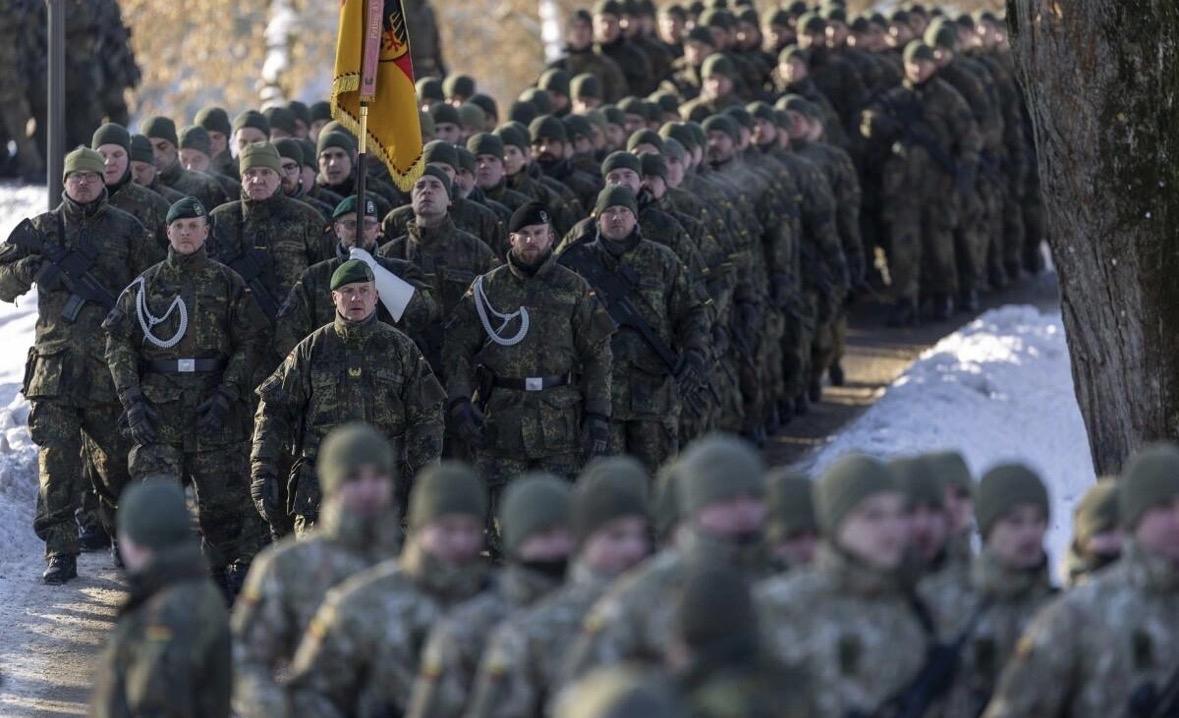
From Berlin’s perspective, the timing is bad. Its brigade in Lithuania is far from reaching its full strength. Around 1,800 troops are currently deployed, while the planned expansion to 5,000 soldiers is not expected before 2027. Even at full strength, the brigade is meant to deter and is not designed to win a major war on its own.
However, Berlin wants to appear ready for a fight. Orders are given to increase training activities in Lithuania and to reinforce the German brigade. The navy is mobilized and additional ships are prepared for deployment to the Baltic Sea. Yet, these measures are time consuming, requiring two to three weeks to take effect.
In the simulation the Russians view Germany’s response as slow and cautious, a pattern officials believe they have seen before. What the simulation made clear is that the greatest risk may not be Russia’s military power, but Western hesitation. In a crisis measured in days, responses planned in weeks may come too late. The war game was fictional, but the strategic weaknesses are a point of concern.
The simulation met considerable criticism from Baltic officials. Estonia’s ambassador to the United Kingdom, Sven Sakkov, described many such exercises as “frankly insulting,” saying that frontline states are often thought of as passive victims rather than capable actors with agency. He emphasised that Estonia alone could mobilize approximately 50,000 fighters at short notice and noted that Latvia and Lithuania demonstrate similar abilities.
Lithuanian Colonel Gintaras Bagdonas described the scenario as “nonsense” and questioned whether the war game was excessively political. Baltic officials declared that their national armed forces would respond immediately to aggression, despite likely delays in NATO’s political decision-making. Researchers, including Dr. Eoin McNamara of the Finnish Institute of International Affairs, have also observed that many simulations underestimate local resistance, reserve mobilisation, and the NATO airpower already present in the region.
The organisers clarified that the exercise was not intended to predict a Baltic defeat, but rather to examine German decision-making in a scenario in which NATO could be politically incapable, particularly in the absence of clear American leadership. According to Die Welt’s security correspondent Carolina Drüten, war games serve as analytical abstractions designed to test weaknesses rather than offer factual forecasts of reality.
Following Russia’s full-scale invasion of Ukraine, European nations have significantly increased defence spending and military preparedness. Germany announced its historic Zeitenwende, committing €100 billion to modernise its armed forces. Poland and the Baltic states have raised their defence budgets well above NATO’s 2% target, while Finland and Sweden have increased their contributions. NATO troop deployment in the Baltics has expanded, air policing missions have intensified, and rapid-reaction capabilities have improved.
While the war game revealed certain vulnerabilities, it also prompted debate. Rather than indicating inevitable defeat, the simulation points out the importance of speed and unity.
Sources:
- German wargame simulating Baltic attack dismissed as ‘insulting’ and ‘nonsense’ | News | ERR
- Ernstfall-Podcast: Wargame exposes gaps in Germany’s response to a hypothetical Russian attack on Lithuania – WELT
- German wargaming ignores Baltic forces, sees Russia seize Suwalki Gap – LRT
- Enter the “gray zone”: Russia is already at war with Europe. Germany’s wargame missed it – Euromaidan Press