Author: Giulia Cimaglia
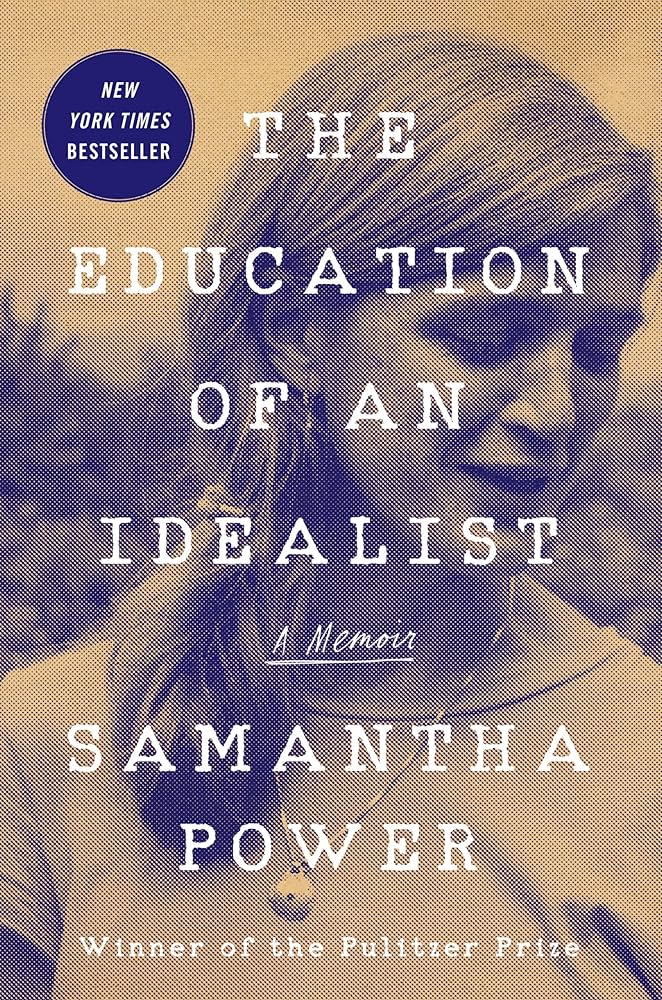
A person’s political convictions often change with time. When one asks a teenager what their stance on – say – universal healthcare is, they might answer optimistically: “healthcare should be free for everyone regardless of legal status or income.” With time, though, the meanders of life might make them less politically optimistic, or “idealistic.” Samantha Power, former United States Ambassador to the UN, is special in the sense that she is someone who never lost this pure idealism. In fact, her exposure to some of life’s greatest challenges has only embraced her idealistic conception of the world. What is more, her Pulitzer-prize winning memoir The Education of an Idealist proves that the grim, and slightly erratic state of today’s political arena is highly in need of a so-called “idealistic revolution.”
What is Idealism?
Idealism is a type of political philosophy which we can trace back to the fourth century BCE, the period of Plato. Indeed, idealism started out as a set of metaphysical perspectives which stated that reality is fundamentally equal to mind, spirit or consciousness. In other words, according to this way of thought, ideas are the highest level of reality. This conception has also adopted a political meaning over time: political idealism asserts that a nation’s foreign policy should reflect its internal values. Samantha Power thus writes in The Education of an Idealist that the USA’s foreign policy ought to echo the respect for human rights, the rule of law and the pursuit of happiness the Constitution guarantees. That has however rarely been the case.
Who is Samantha Power?
Samantha Power was born in London in 1970. She was raised in Dublin until she was nine, when her parents separated due to the father’s alcoholism. They then moved to Pittsburgh, a city in Pennsylvania. Power then went on to graduate from Yale and Harvard Law. She worked as a war correspondent covering the Yugoslav Wars in the 1990s, before working for the US National Security Council. Her career in politics was sealed when she joined Barack Obama’s presidential campaign in 2008, before serving in his cabinet and ultimately working as his Ambassador to the UN.
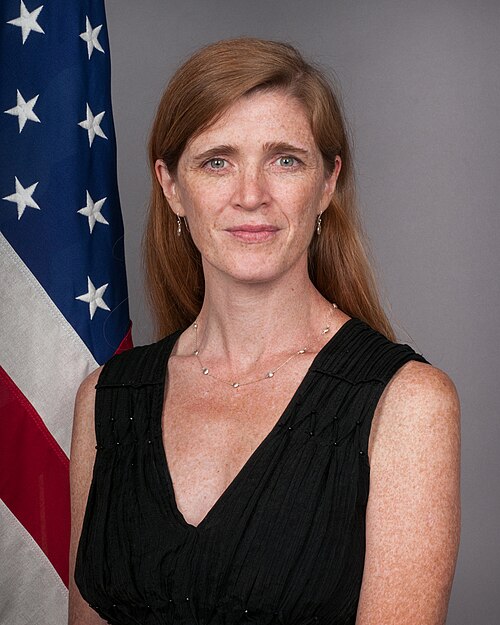
Power’s life has thus exposed her to various political crises of very different natures. from on-the-ground reporting in Bosnia to high-stakes decision making in the United Nations. Samantha Power has also described these experiences as having contributed to her multi-faceted and ambivalent political perspectives. On this ambivalence she writes:
“F. Scott Fitzgerald famously described the importance of being able “to hold two opposed ideas in the mind at the same time,” while still retaining “the ability to function.” I was quickly becoming practiced at this discomfiting balance.”
This “ability to function” is proof of the firmness of Power’s political positions, the vast majority of which are unchanging. On the question of genocide, Power has stressed since the early 2000s that the US should act with “immediate military force” in order to actively prevent a genocide, or threats of. This was her primary thesis in her book A Problem from Hell.
Power’s Defense of Idealism
The Education of an Idealist, although an account of Power’s professional and personal experiences, is above all else a vindication of idealism as a political philosophy. Her idea is simple: foreign policy should not be exempt from the same kind of scrutiny that domestic policy gets. In other words, nations built on the promise of human rights and dignity should advance these values on the global political stage. This also entails that the use of military force should only be reserved for humanitarian purposes or defense of an invader.
In addition, idealism is also about conviction and courage – both national courage and individual. Power stresses that individual courage in the face of scrutiny or crisis is as important as politicians’ ability to defend their stances on the global level. In her memoir she writes:
“People who care, act, and refuse to give up may not change THE world, but they can change many individual worlds.”
One of idealism’s fundamental doctrines being that ideas reflect reality, if the constituency of a nation is comprised of individuals willing to fight for change, to stand up for their moral convictions, then this hunger for change and justice will be echoed on the national level over time, before eventually being reflected in the foreign policy of said nation. Thus, Power stresses that change should occur on the individual level first, as a politician’s strength is made from their constituency’s firmness. This reminds us of a fundamental democratic principle: aren’t politicians a reflection of who voted for them? Strong voters make strong politicians, who then make strong nations.
Power gives the example of civil rights when discussing individual idealism. Her experiences in a Pennsylvania High School exposed her to the inequalities between the Caucasians and racial minorities:
“To this day, when I hear people judge students on the basis of their test scores, I think of my sleep-deprived African-American classmates as we geared up to take English or math tests together. We may have been equal before God, but I had three more hours of sleep, vastly more time to prepare, and many more resources at my disposal than those who were part of the busing program.”
For Samantha Power, idealism was thus always about equality of the races, sexes, and people in general. In The Education of an Idealist, Power often spends multiple pages advocating for undocumented immigrants and refugees (most of which – she mentions – are women and children), religious and racial minorities, and LGBTQ+ rights.
Key Takeaways
Samantha Power teaches her readers that while the political arena is an ever-changing world, with what seem to be incessant convulsions and crises, personal convictions and national positions on foreign policy should remain constant. Perseverance is key in establishing a peace-oriented political world.
Power also displays the primal role of people in the decisions of their elected officials: a healthy democracy should always reflect the will of the people. Thus, it is our responsibility to unconditionally defend our values, and to never be afraid of doing so. We should also cease to neglect foreign policy, one of idealism’s key ideals is that all peoples of the world are created equal, no matter where they were born. Nations should thus take more time to defend individual peoples’ rights all around the world: as mentioned previously, the violence of military force should be used for humanitarian purposes only: they should embrace human life and dignity, not undermine it. People and nations should only always get involved in conflicts for the purpose of solving them. Courage to act is The Education of an Idealist‘s main message:
“We decide, on issues large and small, whether we will be bystanders or upstanders.”
Edited by: Olivia Pataki
Cover Image: Anfaenger from Pixabay https://pixabay.com/photos/flag-heaven-city-new-york-3158666/