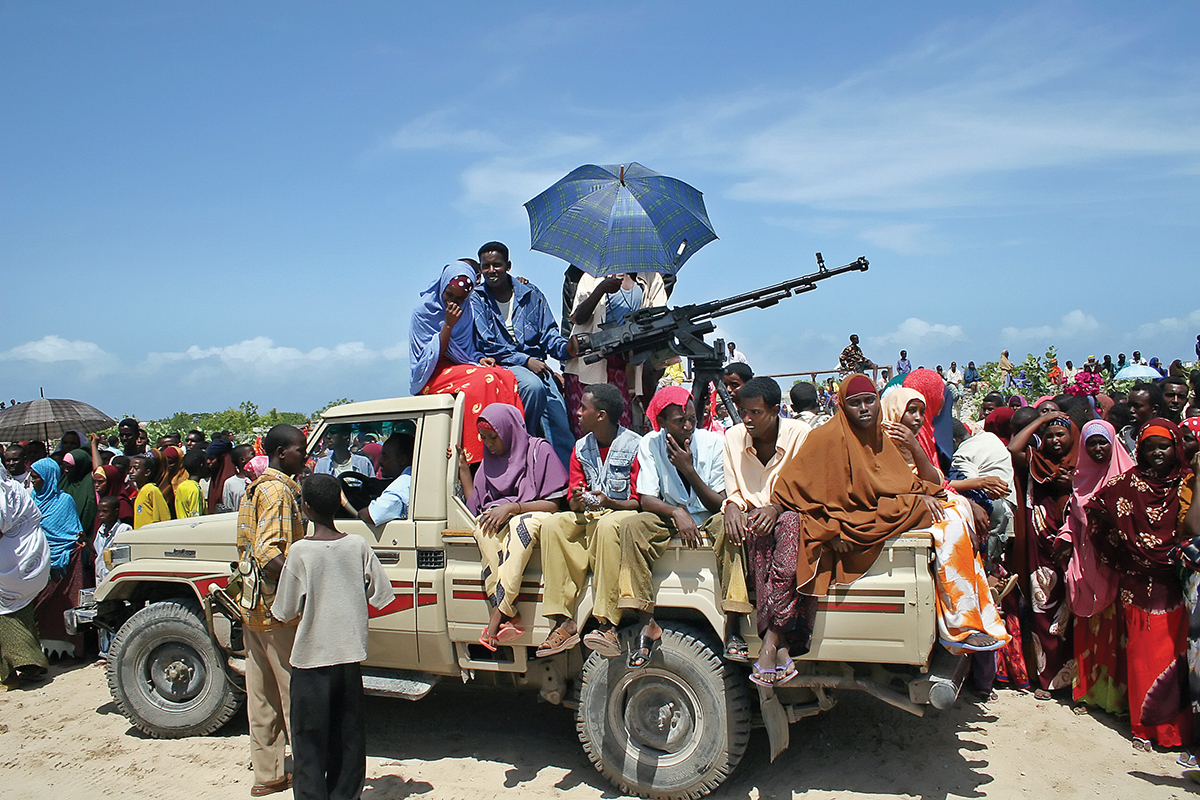
A car bomb in the capital. An assassination days later. A government still fighting to hold territory.
Somalia is currently the world’s most unstable country in the world, and its problem is rooted in the country’s history of Colonial Ruling. In the late 19th and early 20th century, Somalia was divided among several different European colonial powers; The British controlled northern Somaliland, the Italians governed southern Somalia, and the French occupied what is now Djibouti. Despite ongoing efforts, Al-Shabaab remains a persistent and deadly force, using coordinated attacks to destabilize the state and keep civilians living in fear.
Author: Theo Jun Shimabucuro
Historical Context Leading to Instability:
Somalia is currently the world’s most unstable country in the world [1], and its problem is rooted in the country’s history of Colonial Ruling. In the late 19th and early 20th century, Somalia was divided among several different European colonial powers; The British controlled northern Somaliland, the Italians governed southern Somalia, and the French occupied what is now Djibouti [2].
Early Italian colonial rule lasted from 1889 up until 1936, where Italy gradually took control of southern Somalia, signing protectorate agreements with local sultans in the late 19th century. And by 1908, Italian Somaliland was officially established as a colony. Through military expansions in 1935-1936 Italy gained control of the Ogaden Region which was historically claimed to be Somali but was under eastern Ethiopia’s control. The northern region of Somalia however, remained under British rule since 1884 and Italy was never able to seize full control of the region even after the conquest of Ethiopia, where Italy merged Italian Somaliland, Eritrea, and Ethiopia into Italian East Africa in June 1936[3] [4]. During the second world war Italy invaded and briefly occupied British Somaliland in 1940. However, in 1941, British and Commonwealth forces recaptured British Somaliland and Italian Somaliland, ending Italy’s rule in Somaliland.[5]
After WWII although Britain controlled Somalia from 1941 to 1950, the United Nations decided to give Italy the mandate to administer the country under a trusteeship system. This meant that under Italy’s control as the administering authority, Somalia was to become independent in 10 years. Between 1950 and 1960 (the year when Italy relinquished its Somali territory back to the Somali people), Italy had to prepare Somalia for full independence Somalis were to be gradually given political roles and leadership training so that Italian Somaliland could become the independent State of Somaliland. In that transition period for Somali independence a Somali Legislative Council was formed (1956), allowing Somalis to participate in lawmaking. Political parties, especially the Somali Youth League, gained influence. Italian authorities expanded education and infrastructure, introducing Somali language curricula alongside Italian in schools. Roads, hospitals, and ports were developed to prepare for independence. Finally in 1959, Somalia held elections for a self-governing government and on July 1, 1960, Italian Somaliland and British Somaliland united, forming the independent Somali Republic which was governed by The Somali National Assembly. The civilian-led government lasted until 1969 when led by Mohamed Siad Barre the Supreme Revolutionary Council seized power in a bloodless coup. [6]
Following Barre’s success in taking over the Somali government, the Soviet Union and Somalia aligned themselves diplomatically thanks to their aligning their shared socialist views and anti-colonist sentiment. The Soviets also saw Somalia as a strategic territory in the Horn of Africa that offered direct access to the Red Sea and Indian Ocean trade routes. The USSR provided Somalia with military aid, offering weapons and training to the Somali National Army, turning the country into one of the most armed states in Africa. The Soviets also helped build infrastructure, including roads, ports, and military bases.[7] And so, through all this influence from the USSR, Somalia aligned its political ideologies with theirs adopting a Marxist-Leninist policy of an economy and authoritarian governance controlled by the state. On July 11, 1974, Somalia signed a Friendship and Cooperation Treaty with the Soviet Union.[8] This treaty solidified military, economic, and political cooperation between the two nations, deepening Somalia’s ties to the Soviet bloc.
The treaty between Somalia and the USSR, however, was not enough to stop the Soviet Union’s thirst for influence in Africa at any cost. In 1977, three short years after the signing of the treaty, the Soviet Union betrayed Somalia. In 1977, Siad Barre, supported by his Soviet-supplied military, invaded Ethiopia’s Ogaden region, aiming to unite Somali ethnic territories into a “Greater Somalia.” And initially, Somalia made some territorial gains, but the conflict took a turn for the worse. Ethiopia’s pro-Western monarchy had been overthrown in 1974, and a new Marxist-Leninist regime called the Derg, led by Mengistu Haile Mariam [9], took power. Seeing an opportunity for greater influence, the USSR switched sides, abandoning Somalia and instead supporting Ethiopia with weapons, military advisors, and Cuban troops[10].This intervention resulted in a Somali defeat and the loss of the Ogaden region. Somalia felt betrayed and abandoned by its former ally, and Barre, in response, cut ties with the USSR, expelled Soviet advisors, and turned to the West for support.
The failure in Ogaden weakened Barre’s rule, worsened the economy, and increased internal discontent, setting the stage for civil war. Soviet military aid created one of the strongest armies in Africa, but after Soviet abandonment and later Western disengagement, these weapons fell into the hands of clan militias and warlords. The Somali government, led by Siad Barre, collapsed in January 1991 after years of internal rebellion, economic decline, and clan-based insurgency [11]. Clans and militias fought for control of Mogadishu and other regions. The country lacked a centralized government, leading to massive displacement and famine. And in 1993 the Black Hawk Down incident took place, where U.S troops were attacked by militia forces during a UN humanitarian intervention[12]. In the absence of a central government, Islamic courts began to provide governance and justice in some areas. In 2006, the Islamic Courts Union (ICU), an Islamist coalition, briefly seized control of Mogadishu, introducing a Sharia-based rule. Ethiopia, fearing an Islamist takeover, invaded Somalia in the same year with U.S. support, leading to the ICU’s defeat[13]. After the ICU’s collapse, the extremist group Al-Shabaab emerged, conducting terror attacks and guerrilla warfare. To this day Al-Shabaab controls parts of rural Somalia and continues to attack government forces, AMISOM (African Union Mission in Somalia), and civilians. The group has also conducted terrorist attacks in neighboring Kenya and Ethiopia[14].
The Current State of Somalia: A Struggle for Democracy
Somalia has attempted to rebuild democratic institutions; however, these efforts have been faced with severe obstacles. Somalia’s current government operates under a federal system, with significant power held by regional states. Elections are indirect, meaning clan elders and political elites choose leaders, which limits true democracy. Political leaders are often accused of corruption, nepotism, and vote-buying [15]. Politics in the country is dominated by clan rivalries rather than national interests. Power-sharing among factions follows the 4.5 clan formula [16], which gives major clans equal representation while marginalizing minorities, making it a system that fuels discontent and infighting among the factions. Somalia is currently battleground for regional and international powers, including Ethiopia, Kenya, the United Arab Emirates, Turkey, and the United States of America. These powers support different factions, fueling further instability, and since Somalia has little to no influence or authority over these external influences from other nations, the Somali government finds itself in a position where they cannot stop the factions and militias within the state.[17]
Despite ongoing efforts to stabilize Somalia, the country continues to face a complex web of challenges. The Somali government, with the support of international partners, has made strides in combating Al-Shabaab and reestablishing control over key territories. However, the militant group remains a persistent threat, employing suicide bombings, assassinations, and guerrilla warfare to destabilize the government and terrorize civilians.[18] [19]
The African Union Transition Mission in Somalia (ATMIS), the successor to AMISOM, continues to assist Somali forces in counterterrorism efforts, but security remains fragile. Corruption, weak institutions, and limited access to justice have also contributed to the slow progress in governance. Many government officials are accused of embezzling public funds, and judicial systems remain dysfunctional, failing to uphold the rule of law.
Additionally, Somalia is facing an ongoing humanitarian crisis[20]. The country experiences frequent droughts and famines, exacerbating food insecurity and displacing millions of people. Climate change has worsened these issues, making it difficult for farmers and pastoralists to sustain their livelihoods. The humanitarian response, although supported by international organizations, remains insufficient to address the needs of the growing internally displaced population. Healthcare and education systems are underdeveloped, leaving many Somali citizens without access to essential services. The combination of these factors has perpetuated a cycle of poverty, insecurity, and reliance on foreign aid, making Somalia’s path to recovery even more challenging.
The Future of Somalia: A Potential Stable Democracy
Looking toward the future, Somalia’s prospects for achieving a stable democracy depend on several critical factors. Strengthening political institutions and eliminating corruption will be essential for fostering public trust in the government. Electoral reforms that allow for direct voting instead of the current indirect system will help enhance democratic participation and reduce the influence of clan-based politics [21]. Additionally, fostering economic growth through investment in infrastructure, education, and job creation can help alleviate poverty and reduce dependence on external aid. International partners must continue to help in counterterrorism efforts while ensuring that Somali security forces develop the capacity to maintain stability on their own. If Somalia can successfully implement these reforms and navigate its complex political landscape, the country may eventually overcome its historical challenges and move toward a more stable and democratic future.
Furthermore, regional cooperation and diplomatic engagement will be crucial for Somalia’s long-term stability. Strengthening relations with neighboring countries such as Ethiopia and Kenya, while resolving territorial and political disputes, can create a more stable environment for trade and development [22]. Investment in regional infrastructure, such as ports and transportation networks, can boost economic opportunities and facilitate stronger ties with international markets. Additionally, promoting reconciliation among Somalia’s clans and diverse communities will be essential in fostering national unity and a sense of collective identity. With a concerted effort from both domestic leaders and international allies, Somalia has the potential to emerge as a resilient and self-sustaining democracy in the coming years.
Resources
Websites
- [1] The Fund For Peace (2024). Global Data | Fragile States Index. [online] fragilestatesindex.org. Available at: https://fragilestatesindex.org/global-data/.
- [2] Lewis, I. (2024). history of Somalia | Britannica. [online] www.britannica.com. Available at: https://www.britannica.com/topic/history-of-Somalia.
- [3] Encyclopedia Britannica. (n.d.). Italian Somaliland | historical colony, Africa. [online] Available at: https://www.britannica.com/place/Italian-Somaliland.
- [4] Encyclopedia Britannica. (n.d.). British Somaliland | historical region, Somalia. [online] Available at: https://www.britannica.com/place/British-Somaliland.
- [5] State.gov. (2023). Background Notes: Somalia. [online] Available at: https://1997-2001.state.gov/background_notes/somalia_0798_bgn.html.
- [6] U.S. Department of State. (2017). Somalia (10/03). [online] Available at: https://2009-2017.state.gov/outofdate/bgn/somalia/36384.htm.
- [7] CIA. (2004). Intelligence memorandum | soviet-somali relations [online pdf] available at: https://www.cia.gov/readingroom/docs/CIA-RDP85T00875R001100180002-5.pdf
- [8] State.gov. (2025). Historical Documents – Office of the Historian. [online] Available at: https://history.state.gov/historicaldocuments/frus1969-76ve06/d168.
- [9] Encyclopedia Britannica. (n.d.). Mengistu Haile Mariam | president of Ethiopia. [online] Available at: https://www.britannica.com/biography/Mengistu-Haile-Mariam.
- [10] Office of the Historian (n.d.). Milestones: 1977–1980 – Office of the Historian. [online] history.state.gov. Available at: https://history.state.gov/milestones/1977-1980/horn-of-africa.
- [11] UPI. (n.d.). Somali president flees; rebels control capital – UPI Archives. [online] Available at: https://www.upi.com/Archives/1991/01/27/Somali-president-flees-rebels-control-capital/1808664952400/.
- [12] Swift, J. (2023). Battle of Mogadishu | Description & Facts | Britannica. [online] www.britannica.com. Available at: https://www.britannica.com/topic/Battle-of-Mogadishu.
- [13] Stanford.edu. (2016). Islamic Courts Union | Mapping Militant Organizations. [online] Available at: https://stanford.edu/group/mappingmilitants/cgi-bin/groups/print_view/107.
- [14] National Counterterrorism Center (2015). National Counterterrorism Center | Groups. [online] www.dni.gov. Available at: https://www.dni.gov/nctc/groups/al_shabaab.html.
- [15] WDN (2024). Inside the Federal Parliament of Somalia Leadership: Corruption and Its Impact on Governance and Stability – WardheerNews. [online] WardheerNews. Available at: https://wardheernews.com/inside-the-federal-parliament-of-somalia-leadership-corruption-and-its-impact-on-governance-and-stability/
- [16] reliefweb.int. (2023). The role of 4.5 in democratization and governance in Somalia: Implications and considerations for the way forward (May 2023) – Somalia | ReliefWeb. [online] Available at: https://reliefweb.int/report/somalia/role-45-democratization-and-governance-somalia-implications-and-considerations-way-forward-may-2023.
- [17] External Actors in Stateless Somalia A War Economy and its Promoters. (n.d.). Available at: https://www.files.ethz.ch/isn/14400/paper39.pdf
- [18] United Nations (2024). As United Nations Somalia Mission Draws Down, Speakers in Security Council Urge Government Continue Efforts on Security Sector Reform, Fight against Al-Shabaab | Meetings Coverage and Press Releases. [online] press.un.org. Available at: https://press.un.org/en/2024/sc15741.doc.htm.
- [19] BBC (2017). Who are Somalia’s al-Shabab? BBC News. [online] 22 Dec. Available at: https://www.bbc.com/news/world-africa-15336689.
- [20] Organised Crime Index (2023). Criminality in Somalia – The Organized Crime Index. [online] ocindex.net. Available at: https://ocindex.net/country/somalia.
- [21] Un.org. (2024). Somalia Advancing Democratization Process, Other National Priorities ahead of UN Assistance Mission’s Transition, Special Representative Tells Security Council | Meetings Coverage and Press Releases. [online] Available at: https://press.un.org/en/2024/sc15843.doc.hm.
- [22] Jazeera, A. (2024). Somalia, Ethiopia agree on compromise to end tension, Turkish leader says. [online] Al Jazeera. Available at: https://www.aljazeera.com/news/2024/12/12/somalia-ethiopia-agree-on-compromise-to-end-tension-turkish-leader-says.