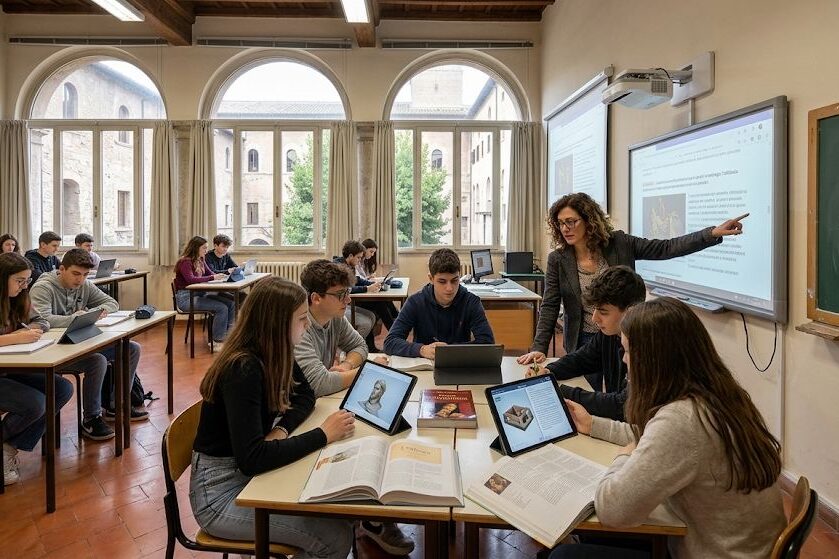
As Italy navigates a period of significant economic and political transition, the national public school system finds itself at a defining crossroads. Often viewed as a reflection of the country’s broader stability, the educational sector is currently undergoing a wide-ranging evaluation, aiming to harmonize historical academic excellence with the logistical and technological requirements of the 21st century. This journey of modernization, while challenging, is being handled with a focus on long-term growth rather than short-term hurdles.
Author: Alessandro Mannatrizio
Rome – As Italy navigates a period of significant economic and political transition, the national public school system finds itself at a defining crossroads. Often viewed as a reflection of the country’s broader stability, the educational sector is currently undergoing a wide-ranging evaluation, aiming to harmonize historical academic excellence with the logistical and technological requirements of the 21st century. This journey of modernization, while challenging, is being handled with a focus on long-term growth rather than short-term hurdles.
The physical state of Italian schools-the infrastructure-is perhaps the most visible sign of this transition. Many institutions are housed in magnificent, historic buildings that pose unique maintenance challenges. While Italy works to update these structures to meet modern safety and energy standards, other EU nations like the Netherlands or Denmark often utilize more flexible, modular “campus” designs. However, Italy’s commitment to preserving the cultural value of its schools provides a unique learning environment that few other nations can replicate, provided that the current investments in renovation continue to flow steadily.
In terms of the digital transition, Italy has made impressive strides. Moving away from a purely textbook-based approach, the “Piano Scuola 4.0” is introducing high-speed connectivity and interactive tools to classrooms across the country. When compared to the Nordic countries, which integrated digital literacy into their core curriculum decades ago, Italy is in a “catch-up” phase, but one characterized by rapid enthusiasm. The challenge remains ensuring that a student in a rural area has the same digital access as one in a major tech hub as Milan, a regional disparity that is less pronounced in smaller, more centralized EU states.
The central component of the system, teacher training and teaching methods, is also evolving. Traditionally, the Italian method is celebrated for its deep theoretical rigor, producing students with exceptional critical thinking skills. However, the political landscape has recently shifted focus toward more practical, continuous training for educators.
In contrast to the French system, which is highly standardized, or the Finnish model, which prioritizes “phenomenon-based learning” (moving away from traditional subjects), Italy is seeking a middle ground. The goal is to maintain its famous classical rigor while incorporating the collaborative, project-based methods seen in many Western European neighbors.
Ultimately, Italy’s educational path is one of careful balance. While economic fluctuations can create a sense of uncertainty regarding funding and recruitment, the underlying structure remains resilient.
By looking at the successes of its EU partners, Italy is not simply copying foreign models, but is instead weaving international best practices into its own rich educational tapestry. This measured approach to reform ensures that while the methods may change, the fundamental goal-creating well-rounded, cultured, and capable citizens-remains constant.