Author: Anna Maria Sophia Teles Krappitz
Although most people can recognise the wrong in slavery, unbelievably, 54% of white Americans do not believe that giving increased attention to slavery and racism is a good thing. But how can this possibly be when it is widely known that slavery had unthinkable effects over the lives of millions of individuals? This may be because white people aren’t well-educated on all the injustices that African-Americans suffered from, but it is not just Americans who need to learn, but people everywhere. We cannot let history be forgotten, it is there to teach us not to betray our moral conscience ever again.
“I think, therefore I am”
René Descartes, 1637 Discourse on the Method
This famous quote by Réne Descartes is simple, but nonetheless true. It so easily shows that we are all living beings who matter equally in light of our intellectual capabilities. But this fact, somehow, got lost in translation by the slave-owners and traders who dared to call the African-American slaves by “chattel”. The moment African-Americans stepped on the shores of the American colonies, they lost their rights, as a supposedly “great” nation stripped them of their freedom for a greater economic gain. They weren’t treated as humans, but yes as inferiors who were to serve the greedy white man, for far too long.
“The white man’s happiness cannot be purchased by black man’s misery”
Frederick Douglass, Narrative of the Life of Frederick Douglass
For people who followed the word of God, white men were incredibly inhumane towards the
slaves, and it begs the question: would they not have been the “inferior beings,” acting as savagely
as they did? In other words, were they not exhibiting qualities of the utmost cruelty and disregard for the sanctity of human life?
The conditions that the slaves had to live in corresponded to an unimaginable plight, with a detailed
account of their state being regarded in: “Injured Humanity; Being A Representation of What the Unhappy Children of Africa Endure from Those Who Call Themselves Christian” published by Samuel Wood. This man is able to give a factual account on how slaves lived, showing the naked truth for all it was.
According to his text, when slaves were bought, they were marked on the chest with hot iron, and, the second their day started, the slaves were to be out to work, and if they were a second too late they were flogged. They were forced to work till the last atom of their strength, having to endure 18 hours of work, daily. The work was too much, and the lack of sleep only made things worse, all of this would have caused the slaves to fall asleep from exhaustion, which did happen on a few occasions. For this reason, a girl once collapsed from exhaustion, and lost her hands by the mill when feeding it. The slaves did not have enough rations for the amount of work they did, and they were generally ill fed, being forced to even wear a headpiece to prevent their eating.
But the kind of corporal punishment the slaves endured was far more severe than any form of punishment imaginable. It is hard to even describe to what extent they were abused. And I truly believe that these following accounts show the savagery of the white man, who ironically calls himself “civilised.”
There were many pregnant women who were known that were so severely whipped as to have a miscarriage, with a girl’s death resulting from the mortifying wounds, two days after being beaten.
Some slaves have been known who were severely harmed, and, afterwards, put into a cattle chain that weighed about seventy pounds. This monstrous mechanism served to prevent the men from lying down and falling asleep.
A form of punishment that the colonialists seemed to take “pleasure” in using was skin mutilation. A planter of the name Rushie had hot lead dropped upon himself and another man was thrown into boiling cane juice and, as a result, died four days later. African-American slaves lived brutal lives, they endured too much from their “owners”, and their stories weren’t even known.
“This Card Photograph should be multiplied by 100,000, and scattered over the States. It tells the story in a way that even Mrs. Stowe, can not approach, because it tells the story to the eye.”
An unidentified writer for the New York Independent
1862, a year before the emancipation act. A slave of the name “Peter” received a severe whipping, his back covered in scourges and keloid scarring. Whipped Peter spent 2 months recovering from the beating, and thus planned to run away. In 1863, he escaped. But he knew that his master would try to catch him, so he used his wit to devise the perfect plan. He took an onion with him and rubbed it on himself to disguise his scent from the dogs, and reached safety from Union soldiers. Peter came to the decision that he too wanted to enlist in the Union Army, and ended up serving at the front of the revolutionary movement.
During Peter’s time at the Union, his scars were examined and his scourged back was seen. Two photographers heard of him and asked whether he was willing to pose for a photograph. These photographers planned to show the true horrors of slavery, for there were no words to describe their stories: one had to see the truth for themselves.
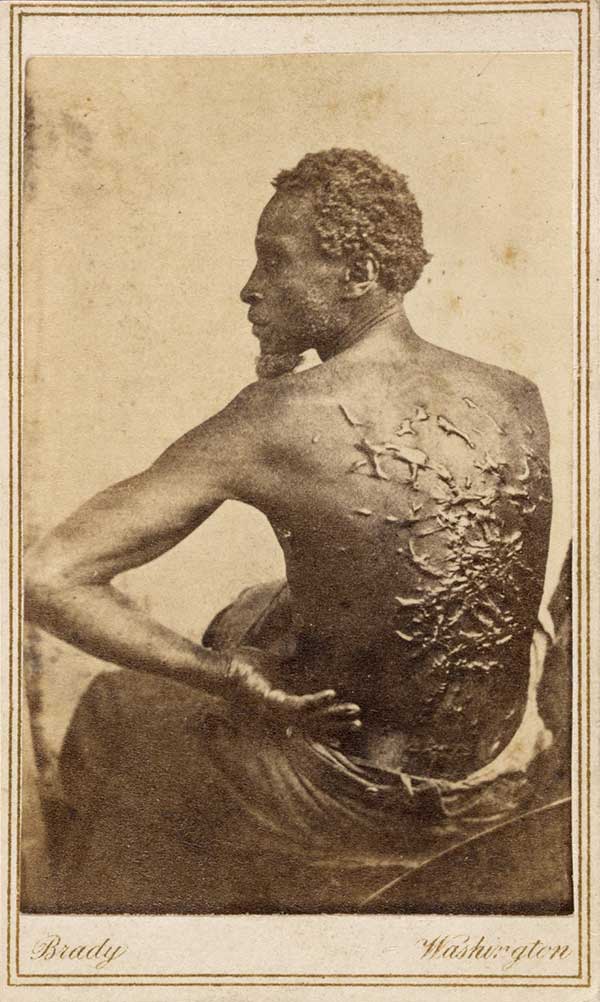
Peter’s portrait was proof of the indictment of slavery, and it told the story of the millions of slaves who lived just like him.
In addition, “Poor Peter” was quite the gallant man; when he served for the Union in Louisiana, he was taken captive by the Confederate, beaten, and left to die, but he miraculously survived and returned once again to the Union lines.
In May of 1683, it was also reported that Peter served as a sergeant in an African-American regiment, and this battle was the first time that African-American soldiers were crucial in an assault on a major Confederate position.
As for Peter’s final fate, much remains unknown, but he lives on as the evidence of the slaves’ resilience.
“Intelligence plus character-that is the goal of true education”
Martin Luther King Jr
People seem to be increasingly uneducated on the subject of slavery, which is a substantial problem. It has been determined that 92% of Americans believe that the civil war was driven by state rights, and not slavery, which means that people are missing out on the much needed context of modern day racism. Schools most definitely need to focus on properly educating students about racism, and not with novels such as “To Kill a Mockingbird” or “The Help” that do not focus whatsoever on the perspective of African-Americans, but instead shine light on the “white saviours.”
It may seem quite sudden to write an article on slavery. Why would I write on a topic that the students at our school are completely unaffected by? Well, I wrote this article for that exact reason.
We attend a school with a majority of white-European students who have never faced racial discrimination, meaning, they may become out of touch regarding the topic of racism. So, with this article, I hope to emphasise the importance of studying racial discrimination to best educate the current generations on how not to be prejudiced by the fickle concept of race.
“Prejudice is a burden that confuses the past, threatens the future and renders the present inaccessible… We may encounter many defeats but we must not be defeated”
Maya Angelou, The Good Samaritan
Edited by: Olivia Pataki
Cover Image by: Clker-Free-Vector-Images from Pixabay
Sources
https://www.gilderlehrman.org/sites/default/files/inline-pdfs/T-05113.pdf