For thousands of years, civilizations have been taking psychedelic mushrooms for their ‘magical’ properties. Historically used for religious ceremonies, today these drugs are often associated with ‘unusual’ and ‘trippy’ experiences. With the help of modern medicine, we may now dig deeper into what makes these mushrooms reality-distorting, their consequences, and why they might help you one day too. 1
Author: Zala Cerkvenik
What Are Psychedelic Mushrooms
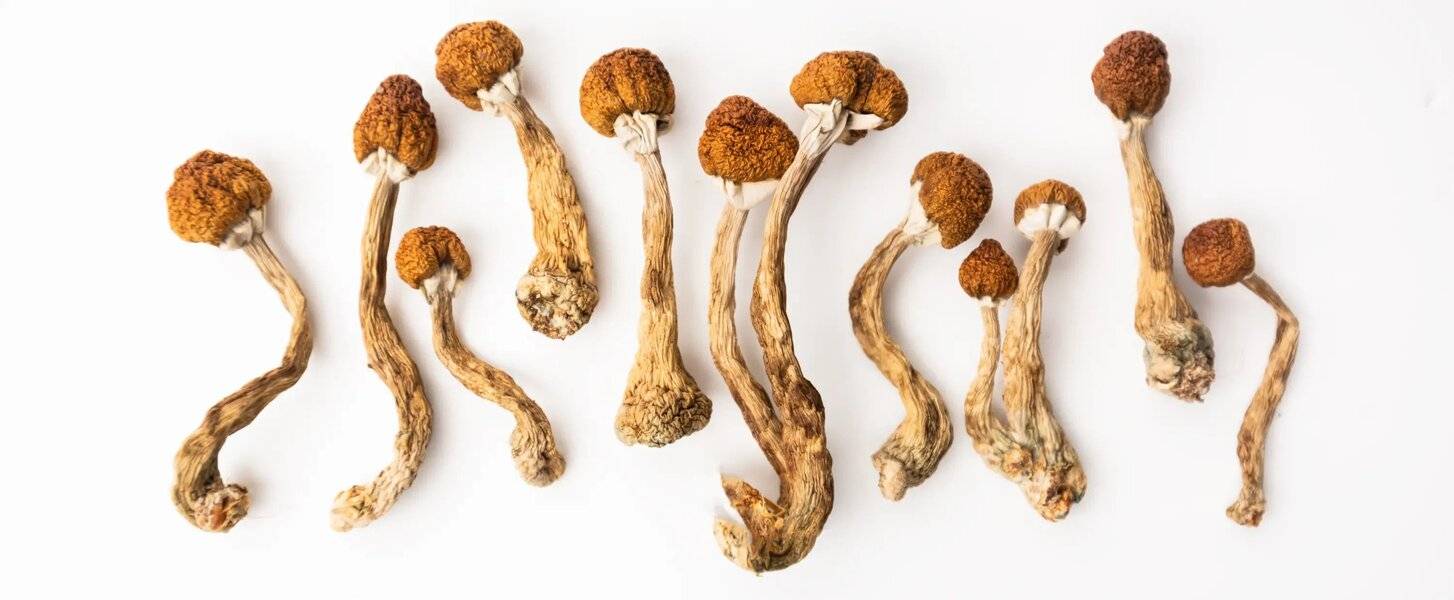
Found on nearly every continent, psilocybin-containing mushrooms are an informal group of fungi most commonly from the genus Psilocybe and can be ingested dried or powdered. Psilocybin is a chemical compound that, when metabolized (liver and enzymes chemically change it), causes changes to a person’s brain activity and impacts perception, mood and thoughts. 2
How Does Psilocybin Affect the Brain?
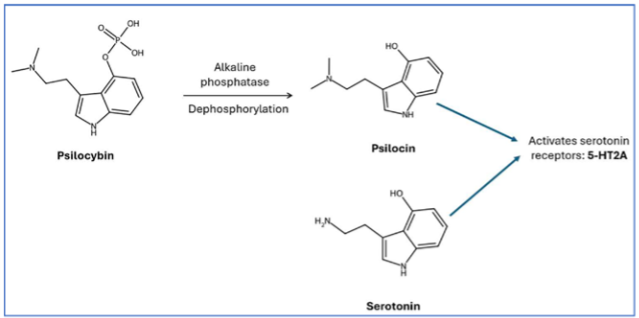
In the body, psilocybin breaks down to psilocin through a process called dephosphorylation, in which a phosphate group is removed by the enzyme alkaline phosphatase. 3Psilocin attaches to and activates serotonin receptors in the brain, specifically the 5-HT2A receptors, which affect mood, cognition, and in other parts of the brain, regulate arousal and panic responses. This also affects perception, both visual and auditory, and may also distort how some people who use the drug perceive objects and people in their environment.
Visuals may be open-eye visuals or closed-eye visuals. In open-eye visuals, an individual may experience objects appearing closer, pattern recognition, acuity of vision, diffraction, distortion of depth perception, the recognition of geometric patterns and colour shifting. In closed-eye visuals, an individual may experience visual noise, light or dark flashes, see patterns, motion, colour, objects and an overriding physical perception. 4Auditory effects make sounds have more clarity and make individuals experience auditory hallucinations, in which they hear words that no one has spoken or sounds that do not come from a stimulus; their minds create sounds.
Psilocybin’s Potential Positives
Medical research on psilocybin is limited and recent; however, studies show promising benefits of the use of psilocybin in the medical field. Research points to psilocybin as a treatment for certain mental health conditions such as depression, post-traumatic stress disorder, obsessive-compulsive disorder, and addictions to alcohol and gambling. Not only that, but scientists are also looking into its effects on cellular ageing, as psilocybin had extended cellular lifespan in certain studies as well as a better quality of life. Concrete data and proven hypotheses must still be confirmed through clinical trials, though. 5
Risks and Effects
Contrary to popular belief, the use of psychedelic mushrooms comes with many risks. Eating magic mushrooms may make you experience a bad ‘trip’, an experience that may be frightening, include paranoia, anxiety, panic, loss of boundaries and a distorted sense of self and, due to impaired judgement, potential injuries or death. Physical effects include an increased heart rate and blood pressure, dangerous to individuals with heart conditions, nausea, vomiting, muscle weakness, twitching, dilated pupils, dizziness, and loss of coordination, visual alterations and distortions, auditory hallucinations, drowsiness, yawning and unusual body sensations.
6Mental effects are derealization, depersonalization, distorted thinking, confusion, frequent or overly intense psychedelic events that may bring forth ‘flashbacks’ and the loss of control over what you are doing. Finally, two great risks with eating psychedelic mushrooms are the possibility of accidentally eating a poisonous mushroom and not a psychedelic one and the increased danger of ingesting them with other drugs.
Legal Status
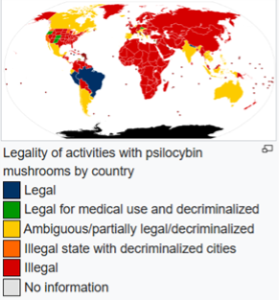
Following the United Nations 1971 Convention on Psychotropic Substances, psilocybin and psilocin are classified as Schedule 1 drugs7. This classification means they are grouped under drugs that have a high potential for abuse and have no recognized medical benefits. This view, however, is being contradicted by emerging medicinal studies, but low funding leads to limited scientific findings, leaving psilocybin and psilocin classified as such. The UN convention requires its members to interdict psilocybin, and parties to the treaty are required to restrict the use of the drug to medical and scientific research in controlled conditions. Therefore, the use and possession of psilocybin is prohibited. However, ‘loopholes’ have been found in the law, and some countries or country states have made their own regulations concerning psilocybin mushrooms. The ‘loophole’ is on the mushroom spores. The spores themselves do not contain psilocybin, so some countries legalized them. Both the Czech Republic and France legalized the cultivation of spores and in every country, the legal status of psilocybin differs. For example, in Estonia, both psilocybin and mushrooms are banned, while in Jamaica they are completely legal (cultivation for private use).
Key Takeaway
Psychedelic mushrooms have been around for thousands of years and are now the subject of science’s interest. Despite ongoing medical research into psilocybin’s benefits, it still carries risks and is illegal in most parts of the world. Understanding and being informed of how drugs work and what their consequences are is crucial to make the right decisions, reduce stigma, increase ability to help and to stop the spreading of misinformation. 8This helps us navigate through life with an objective view of things while protecting us from harm’s way.
If you or someone you know is struggling with a drug-related issue, helplines, therapy and support services are there to help overcome an addiction and stay drug-free. For example, in Belgium, De Droglijn is available to call or to inquire about anything related to drugs.
Cover image by: Brit Weatherbee
Edited by: Kajetan Jankowski, Jeanne Gaudin
- https://nida.nih.gov/research-topics/psilocybin-magic-mushrooms#is-psilocybin-safe ↩︎
- https://en.wikipedia.org/wiki/Psilocybin_mushroom# ↩︎
- https://my.clevelandclinic.org/health/diagnostics/22029-alkaline-phosphatase-alp
https://www.sciencedirect.com/topics/engineering/phosphate-group https://my.clevelandclinic.org/health/articles/22572-serotonin
https://medicine.washu.edu/news/mushrooms-generate-psychedelic-experience-by-disrupting-brain-network/ ↩︎ - https://www.zamnesia.com/blog-what-are-visuals-psychedelics-n2348 ↩︎
- https://www.bcm.edu/news/can-psychedelic-mushrooms-turn-back-the-clock
https://news.emory.edu/stories/2025/07/hs_psilocybin_aging_study_10-07-2025/story.html ↩︎ - https://talktofrank.com/drug/magic-mushrooms#the-risks
https://www.canada.ca/en/health-canada/services/substance-use/controlled-illegal-drugs/magic-mushrooms.html#a4
https://calpoison.org/about-magic-mushrooms-psilocybin-safety
https://www.medicalnewstoday.com/articles/308850#effects ↩︎ - https://en.wikipedia.org/wiki/Legal_status_of_psilocybin_mushrooms ↩︎
- https://www.mayoclinic.org/diseases-conditions/drug-addiction/diagnosis-treatment/drc-20365113#:~:text=Although%20there’s%20no%20cure%20for,is%20important%20to%20prevent%20relapse
https://www.addictionpolicy.org/post/the-power-of-knowledge-why-addiction-literacy-matters ↩︎