Author: Nikita Beljatski
Have you ever found yourself listening to new songs and feeling that something is not right? The music is either too ordinary or too monotonous? You are not the only one since it is confirmed by countless studies and professionals that music, especially modern pop music, is on the decline in quality. Nowadays, many artists choose to make simple music by using common musical templates to reach the top charts leaving no room for uniqueness nor authenticity.
Despite the revolutionary technological changes of DAW and, more recently, AI in the music industry, along with the democratisation of music through audio streaming platforms, there has been a recent decline in the quality of pop music. This decline manifests itself in biased algorithms, loss of authenticity, homogenisation of music, and the rise of AI.
The Democratisation of Music
In 1977, Digital Audio Workstations (DAW) were introduced, and in the 1980s, MIDI (Musical Instrument Digital Interface) was created to facilitate and digitalise the creation, editing, and recording of music. Throughout the 1980s and 1990s, this technology was used, but there were many limitations, such as a limited number of samples, slow processing, and high costs. Therefore, most of the music was performed and recorded in the studio with professional artists playing the instruments, and only some parts were created or edited through DAW. DAW was a revolution that changed the course of music, and today it is the tool that almost all artists use to create, edit, and record their music. Some of the most popular DAW systems are FL Studio and GarageBand.
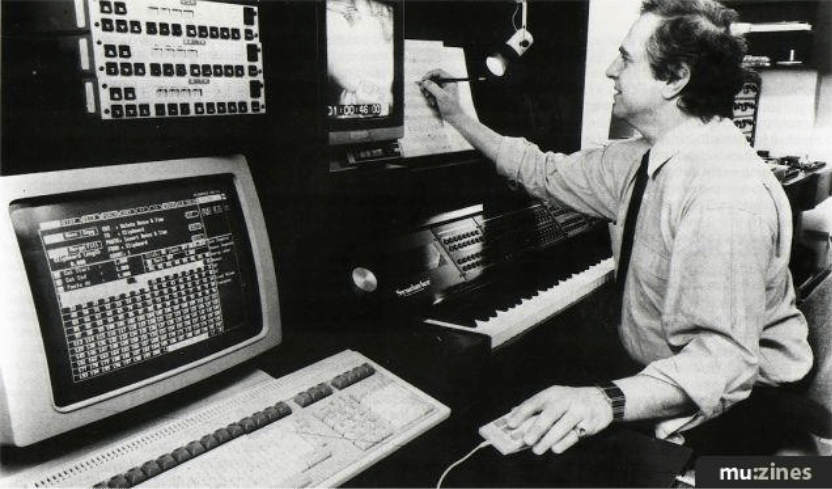
Source: Muzines
The DAW has provided a cheaper way to produce, record and edit music using a diverse set of templates, sounds and instruments in the system. Combined with the rise of audio algorithm-driven streaming services such as Spotify and Apple Music, it has become very easy for artists to create and publish music unlike it was before, where radio stations and labels decided who is heard and what vinyl were sold. Big artists like Tyler, The Creator, Billie Eilish and even smaller creators like Øneheart, whose song “snowfall” became a hit on TikTok in 2022, have tremendously benefited from the new rise of technology in the music industry. These technological tools have democratised music. The people have freedom and access to create and listen to any music. However, despite the benefits, there are many problems associated with the democratisation of music.
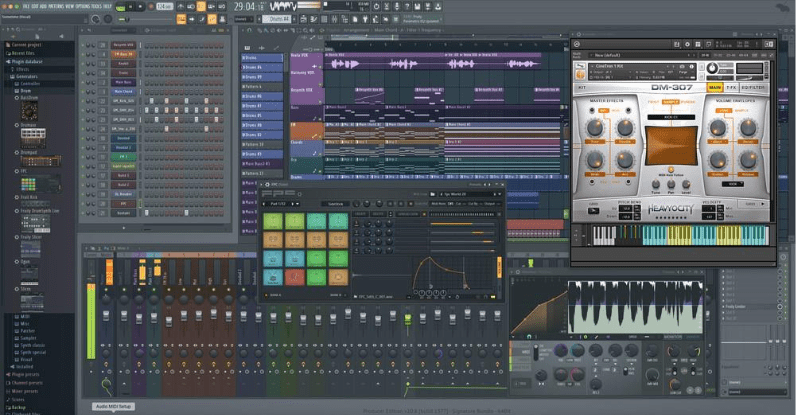
FL Studio
The Downsides of Democratisation
Algorithms
Spotify and other audio streaming services provide a cheap and easy way for artists to publish their music. It provided us the possibility to access all their catalogues with a click for free. The dream, isn’t it? Despite the mechanics of these services, there are many problems related with monetisation and algorithms.
Artists who do not follow the trends and virality of the set algorithms in the streaming platforms, are left unknown in the sea of millions of songs. This forces many artists to “follow” the trends if they want to stay or reach popularity. Talented artists who try to experiment and be creative are usually left unseen due to the cold logic of the algorithms who pick music based on trends and consumers’ music tastes. Furthermore, every week, thousands of songs are released on these platforms, and this number of songs leads to an oversaturation of the market, where it is extremely difficult to find high quality music. Additionally, the monetisation of music on streaming platforms were not well designed for music artists. According to Rolling Stone, artists take only 12 percent of all the income generated by streaming platforms and the music industry. These problems cause music to become less diverse.
Furthermore, despite access to all types of music available, the exact algorithms and platforms decrease our music diversity. According to the study “Effects of Algorithmic Curation on Users’ Music Taste on Spotify,” conducted by the Universidad Complutense de Madrid, the algorithms on Spotify decrease music diversity in listeners. They “can reinforce existing tastes and preferences by suggesting content similar to what users have previously engaged with, potentially limiting exposure to unfamiliar cultural experiences (Gillespie, 2014). The research concludes that these algorithms shape our music tastes without our acknowledgement and create homogenous music experiences because it reinforces repeatedly similar songs and genres. This uniformity of music affects also the quality and the complexity of music.
Simplification and Homogenisation of Music
Due to the heavy usage of similar technologies and the algorithms found in audio streaming platforms, music is becoming simple and uniform. According to a study published in Nature, music—including genres such as pop, rock, and R&B—has become simpler in terms of harmony and lyrics. Countless songs have been analysed and the study revealed that most of modern songs have similar chord progressions, repeated choruses and lyrics, simplified vocabulary, and shorter song length. Additionally, if a song does not have a hook within the first ten seconds, algorithms are likely to disregard it, which explains why many modern pop songs start with a hook.
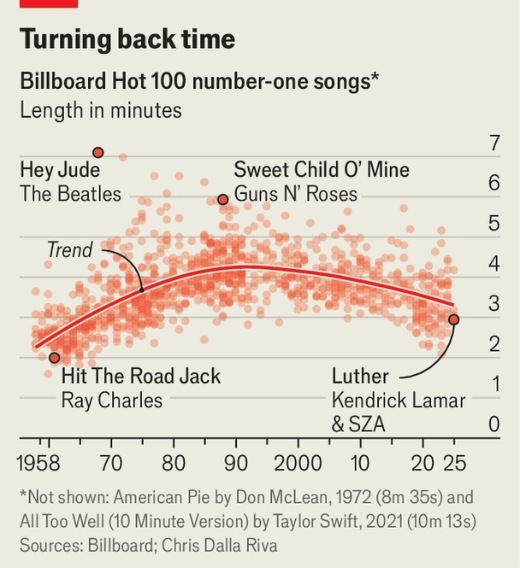
The Economist Gradual decline in song length over the past decades.
Some people would argue that simpler music just sounds better than complex music, which is fair, but the problem is that all of music is becoming simpler and homogenous. The homogenisation of music, when all of music starts to sound similar or even the same, leads to less diversity and uniqueness in music which, as an effect, drops the quality of music. The whole magic and beauty of music is its possibility to be expressed in millions and millions of different possible ways, yet many artists choose to use the similar templates, and to conform the trends of the music industry. In terms of money and time, it is obviously convenient to use past samples, working formulas and musical structures, but this all leads to music becoming too similar. Nevertheless, these problems are not as catastrophic as the implementation of AI in the music industry.
Generative AI and Its Effects on the Music Industry
Nowadays, AI is everywhere and the applications of AI in the music industry is no exception. AI is helping musicians to automate many parts of their work such as music production and marketing, but are these practises fair and ethical?
It is no secret that AI music generators can, with the click of a button, produce complete melodies combined with the voices of real artists. Despite the easiness of the process, this practice raises concerns about copyrights of musical artists’ voices and creative work. In a Harvard article titled “AI Created a Song Mimicking the Work of Drake and The Weeknd. What Does That Mean for Copyright Law?”, Rachel Reed investigates the song “Heart on My Sleeve,” which was created using an AI music generator and AI-generated voices of The Weeknd and Drake. The author of the article mentions that the Copyright Office stated that if the AI-generated music has no human involvement, it does not violate the artists’ copyrights. This raises the question of how AI can be safely used or implemented in the music industry without violating artists’ copyrights.
Furthermore, AI can indeed enhance productivity in music production and music generation of melodies, but it may lead to lack of diversity and make the music sound generic. This adds up with the process of homogenisation of music in the music industry. However, according to the Tracklib Music Producer Survey 2024 (chart below), A large majority of music producers prefer to use AI as an “assistant” rather than a “generator” in music production. The general opinion shows that AI-generated music is incomparable to music created by humans because AI cannot perfectly replicate the ringing quality of a voice or a beautifully executed ritenuto (slowdown in tempo) in a song. This poses the question: will AI continue to affect the music industry or not?
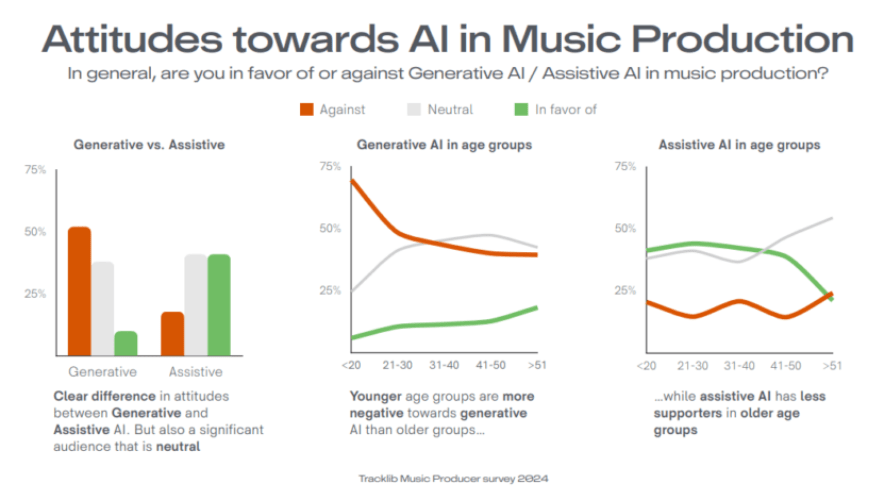
Tracklib Music Producer Survey 2024, image taken from MusicBusiness
Is this the end?
After reading about all the problems in the music industry, ranging from simplification of music to ethical issues of AI use, one may feel pessimistic about the future of music. All these issues deal with uniqueness and authenticity of music. It is no secret that music of the 1980s, 1990s and even 2000s had a special unique and authentic spark to it. Even today, people of all generations still listen to songs from that period—like “Thriller” by Michael Jackson every Halloween—which is played countless times on radio and social media platforms, not to mention Spotify.
These issues are only the tip of the iceberg, but it is not the end. Music changes in cycles and it will certainly evolve into other new and innovative forms and genres. For example, a genre where AI is creatively integrated to it. AI will be implemented, but it will not replace humans—just as it will not replace humans in other spheres of life and work—but instead will serve as an assistant in music production to enhance creativity and efficiency. There are many artists who still express individuality, creativity and authenticity in their work, and this proves that music can remain authentic and meaningful in a world full of algorithms and AI. Music will continue to evolve and see new forms, but there is hope that it will not become even simpler.